Introduction
A line cook grabs the nearest sink to rinse a case of romaine. It's the same sink used for pot washing an hour earlier. That's how contamination risk creeps into a kitchen that otherwise runs a tight operation.
Many facilities underestimate how much sizing and compartment count matter until a health inspector flags the setup, or until a triple-compartment sink turns out to be too small for peak-season produce volume. Both mistakes slow down service and put food safety on the line.
This guide breaks down what a vegetable washing sink is, the size ranges you'll encounter, which stainless steel grade fits your volume, and the compliance details that keep inspectors satisfied. Whether you're outfitting a school cafeteria or a food processing line, you'll know what to look for before you order.
Key Takeaways
- Vegetable washing sinks are multi-compartment, NSF-certified stainless fixtures, not handwash sinks
- Sizing depends on compartment count and produce volume, not a single universal dimension
- 304-grade stainless steel in 14-gauge or 16-gauge is the industry standard for durability
- NSF approval and ADA/TAS compliance are required for commercial and institutional installs
What Is a Vegetable Washing Sink?
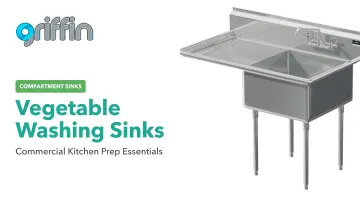
A commercial vegetable washing sink is a multi-compartment stainless steel fixture built specifically for washing, rinsing, and sometimes sanitizing raw produce before it hits the cutting board. It's a different animal from a handwash sink, and it's not interchangeable with a warewashing compartment sink either, even though the two can look similar on a spec sheet.
Under the FDA Food Code, produce washing is treated as a controlled food-preparation step. Section 2-301.15 specifically bars employees from washing hands in a sink used for food preparation or warewashing, which is why dedicated produce sinks matter for workflow separation.
If a warewashing sink doubles as a produce sink, it has to be cleaned and sanitized before and after, adding an extra compliance step most kitchens would rather avoid.
Where It Fits in the Kitchen
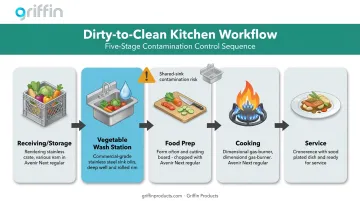
Vegetable washing sinks sit early in the dirty-to-clean workflow, before knives touch anything. You'll find them relied on most heavily by:
- Restaurants and catering operations prepping bulk produce daily
- Food processing plants running high-volume washing lines
- Schools and hospitals, enforcing strict institutional food safety standards
- Cafeterias serving large populations with tight turnaround windows
That early placement matters: keeping raw produce contained at its own station prevents residue from ever reaching prep or dish areas, which is exactly the risk the next section breaks down.
Why the Distinction Matters
Produce isn't a minor contamination source. A CDC attribution analysis of nearly 4,600 outbreaks found that produce accounted for 46% of domestically acquired foodborne illnesses, with leafy vegetables topping the list of individual commodities. That's not cause for panic. It simply means treating the wash station as a controlled process, not an afterthought.
Key Features to Look For in a Commercial Vegetable Washing Sink
Not every compartment sink is built the same way. Here's what separates a well-specified vegetable washing setup from a generic three-bay sink.
Compartment Configuration
- Single-compartment: Fits light-duty operations with lower produce volume
- Double-compartment: Supports a basic wash-then-rinse sequence
- Triple-compartment: Standard for wash, rinse, and sanitize stages, or a full dirty-to-clean flow in higher-volume kitchens
Drain Systems and Drainboards
Basket drains trap skins, stems, and debris at the bottom of the bowl, which reduces clogging and speeds up cleanout. Griffin Products builds every compartment sink line (Wichita, Trinity, Sabine, and Terrell) with basket drains as standard, not an upgrade option.
Integrated drainboards give you staging space before and after washing, cutting down on counter clutter. They're typically offered in 12-, 18-, or 24-inch lengths, left, right, or both sides. Drainboards are a configuration choice, not a universal standard feature, so confirm which SKU you're ordering.
Faucets and Bowl Depth
Commercial faucet styles range from gooseneck and high-arc designs to pre-rinse spray assemblies, and reach matters when you're rinsing bulk greens rather than a single mixing bowl. Bowl depth needs to run deeper than a standard hand sink, too, since you're submerging whole heads of lettuce, not rinsing a coffee mug.
Griffin Products ships its compartment sinks with specification-grade hardware included. Each unit comes with a commercial swing-spout faucet sized to match (commonly 10-, 12-, or 14-inch spouts depending on configuration), basket drains, and a wall-mount installation kit. That removes the guesswork of sourcing faucets and drains separately.
Standard Sizes and Dimensions for Vegetable Washing Sinks
There's no single "standard" vegetable washing sink size. Dimensions shift based on compartment count, expected produce volume, and how much floor space is available.
Single-Compartment Ranges
Bowl dimensions on single-compartment models commonly run from 18" x 18" x 14" up to 48" x 24" x 14–21", depending on the line. Overall footprint (including any drainboard) typically spans 27 to 38.5 inches in length.
Double- and Triple-Compartment Ranges
Multi-compartment sinks scale up accordingly:
| Configuration | Typical bowl size (per compartment) | Overall footprint |
|---|---|---|
| Double-compartment | 15" x 24" to 30" x 24", 12–14" deep | 51 to 74 inches |
| Triple-compartment | 10" x 14" to 24" x 24", 12–14" deep | 75 to 106 inches |
Higher-volume prep areas and food processing environments generally land at the upper end of these ranges. Drainboards account for much of that spread — a bare three-bay sink and one with drainboards on both sides can differ by two feet or more in overall length.
Planning Your Footprint
Before ordering, measure the installation area and check:
- Countertop length needed for the full sink plus drainboards
- Floor clearance for cleaning access underneath
- ADA-required knee space, where the installation falls under accessibility scoping
Griffin Products provides CAD DWG, PDF spec, and Revit RFA files on individual product pages, so architects and facility planners can confirm fit against floor plans before committing to a purchase.
Choosing the Right Material: Stainless Steel Grades Explained
304-grade stainless steel is the industry standard for vegetable washing sinks, and for good reason. It contains roughly 18% chromium and 8% nickel, which forms a self-repairing oxide layer that resists corrosion and keeps the surface non-porous and easy to sanitize between shifts.
16-Gauge vs. 14-Gauge Thickness
Gauge numbering runs backward from what you'd expect: 14-gauge is thicker than 16-gauge.
| Gauge | Best Suited For |
|---|---|
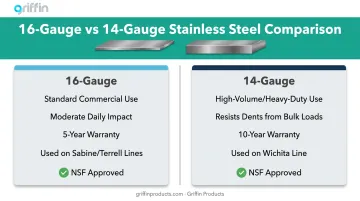
| 16-gauge | Moderate daily use; the standard choice for most restaurant and institutional kitchens |
| 14-gauge | High-volume, heavy-duty operations where the sink takes constant abuse from bulk loads and heavier equipment |
Thinner-gauge sinks can dent under sustained daily impact, so match the gauge to how hard your kitchen actually runs the equipment, not just your budget.
What NSF Approval Confirms
NSF-approved construction verifies weld quality, material safety, and that the surface won't harbor bacteria. This is confirmed through product testing and manufacturing facility audits, not just a stamp on a spec sheet.
Griffin Products manufactures both 14-gauge and 16-gauge NSF-approved stainless steel sinks, handcrafted in Texas. The Wichita line runs 14-gauge with 12-gauge double-welded partitions for industrial demand, while the Sabine and Terrell lines use 16-gauge for standard commercial food service work.
Warranty as a Confidence Signal
Warranty length tracks gauge pretty closely across Griffin's lineup:
| Warranty | Applies To |
|---|---|
| 5-year | Typical on 16-gauge lines like Sabine and Terrell |
| 10-year | Standard on 14-gauge lines like Wichita, reflecting the reinforced, heavier-duty build |
A longer warranty usually means the manufacturer trusts the material and welds to hold up, which is worth checking before you compare prices across vendors.
Compliance and Installation Essentials
NSF Certification
NSF certification confirms a sink's materials, design, and construction meet food-protection standards, including cleanability, bacterial-harborage prevention, and safe food-contact surfaces. Inspectors look for this during health code reviews because it's the baseline proof the equipment was built for food service, not general industrial use.
ADA/TAS Accessibility
Under the 2010 ADA Standards, at least one sink of each type in an accessible space must meet Section 606 requirements. That includes an accessible sink height of 34 inches maximum at the rim or counter, plus compliant clear floor space and knee/toe clearance.
A standard 44-inch floor-mount sink doesn't automatically qualify; accessibility has to be designed in, not assumed. Griffin Products offers ADA and TAS compliant product options for facilities that need to meet these scoping requirements.
Installation Basics
- Drain slope: Follow code minimums based on pipe diameter to prevent standing water and backups
- Water supply hookup: Confirm pressure and flow match manufacturer instructions for the specific fixture
- Installation kits: Use a complete installation kit or hire a licensed plumber to avoid code violations from improvised hookups
Getting this right the first time costs less than a failed inspection re-check.
Frequently Asked Questions
What is a vegetable sink?
A vegetable sink is a dedicated multi-compartment sink built for washing and rinsing produce, kept separate from handwash and dishwashing sinks. It's a standard fixture in commercial kitchens, food processing plants, and institutional food service settings.
What size is a vegetable washing sink?
Size varies by compartment count and expected volume, not one fixed dimension. Single-compartment models typically run 27 to 38.5 inches, while double- and triple-compartment units span 51 to 106 inches depending on drainboard configuration.
What's the best material for a vegetable washing sink?
NSF-approved 304-grade stainless steel, in 14-gauge or 16-gauge thickness, is the preferred material for durability, hygiene, and code compliance. The heavier gauge suits high-traffic locations; 16-gauge handles standard commercial use.
How many compartments should a commercial vegetable washing sink have?
Compartment count should match your kitchen's workflow. A single compartment works for light use, while double or triple configurations support a full wash-rinse-sanitize process for higher-volume prep.
Do vegetable washing sinks need to be NSF certified?
Yes, generally. Food service establishments need NSF-certified equipment to pass health inspections, since certification confirms the sink's materials and construction are safe for food contact.
Can a vegetable washing sink double as a hand wash station?
Most health codes require separate, dedicated hand wash sinks apart from food-prep sinks to prevent cross-contamination. Griffin Products manufactures both, making it easy to outfit a fully compliant kitchen with the right fixture for each task.