Key Takeaways
- Standing urinals come in wall-hung and floor-mounted styles, each suited to different facility types and traffic volumes
- Material choice directly affects durability, hygiene, and long-term maintenance costs — choose based on your facility's demands
- ADA compliance is required when two or more urinals are installed; the maximum rim height is 17 inches from finished floor
- Waterless urinals need cartridge or sealant replenishment every 3,000–7,000 uses depending on the model
- Match fixture specs to your facility's traffic volume and regulatory requirements before purchasing
Introduction
Specifying restroom fixtures for a commercial facility sounds straightforward — until it isn't. A typical product catalog presents a dozen urinal configurations, multiple material options, conflicting rough-in dimensions, and a compliance checklist that spans both federal ADA standards and state-level amendments. Facility managers, contractors, and commercial designers run into this constantly.
Standing urinals are the workhorse of any commercial men's restroom — but "standing urinal" covers a wide range of products. The right choice for a stadium concourse is completely different from the right choice for a school, a commercial kitchen, or a government office building.
Here's what you need to make a confident, code-compliant decision. This guide covers:
- Urinal types and mounting styles
- Material comparisons (vitreous china vs. stainless steel)
- Key specifications to evaluate before purchase
- ADA and TAS compliance requirements
- Maintenance schedules
- A framework for matching the right fixture to your facility
What Is a Standing Urinal? Types and Configurations Explained
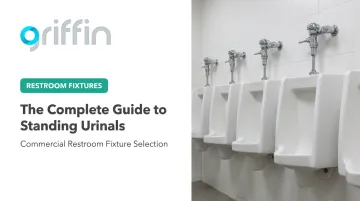
A standing urinal is a plumbing fixture designed for upright use — wall-mounted or floor-level — that drains liquid waste without requiring a seated position. In commercial settings, "standing urinal" and "wall-hung urinal" are often used interchangeably, though the category technically includes floor-level configurations as well.
Mounting Styles: Wall-Hung vs. Floor-Mounted
Wall-hung urinals are the most common commercial type. The fixture is secured to wall supports or hangers, with plumbing connections at the rear or top. Key advantages include easier floor cleaning underneath the unit and flexibility in mounting height to meet accessibility requirements or accommodate different user populations.
Floor-mounted (or stall-type) urinals extend from floor to wall and are sometimes called extended or full-length urinals. They're common in high-capacity environments (stadiums, industrial facilities, correctional institutions) where durability and full-surface cleanability matter more than the footprint savings of a wall-hung design.
Note: Fixture shape doesn't determine mounting method. Kohler's extended K-4960, for example, is still classified as wall-mounted despite its elongated profile. Always confirm the manufacturer's mounting description rather than inferring it from appearance.
Flush Type: Water-Flush vs. Waterless
Water-flush urinals — activated by manual or sensor flushometers — remain the U.S. commercial standard. Per EPA's WaterSense program, the federal standard is 1.0 gallons per flush (gpf), while WaterSense-labeled fixtures average no more than 0.5 gpf. Flushing keeps drain traps clear and is required by most adopted plumbing codes for permanent installations.
Waterless urinals eliminate water entirely, using a cartridge or sealant trap insert to block sewer gas and odors. Three common systems operate differently:
| System | Mechanism | Service Trigger |
|---|---|---|
| Falcon F1000/F7000 | Sealed ABS cartridge with biodegradable sealant | ~7,000 uses |
| Zurn Z5795 | Integral trap with AquaGreen liquid sealant | Add sealant every 3,000 uses |
| Sloan WES-150 | Replaceable Waterfree cartridge | Varies by installation |
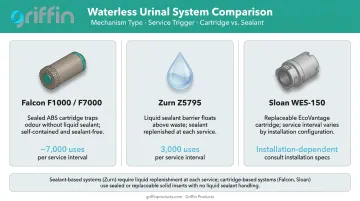
Waterless models are gaining ground in water conservation programs, but their cartridge replacement schedules and sealant costs add up in ways that flush models don't. Factor that in when comparing total cost of ownership.
Standing Urinal Materials: Choosing for Durability and Hygiene
Material selection determines long-term urinal performance — durability, sanitation compliance, and maintenance burden all follow from it. Three materials dominate commercial specifications: vitreous china, stainless steel, and composite/resin. Each carries different durability, hygiene, and cost implications.
Vitreous China and Ceramic
Vitreous china is the most widely specified material in traditional commercial restrooms. It's non-porous, accepts a smooth glaze that's easy to clean, and is available from virtually every major fixture manufacturer. Per WaterSense specifications, ceramic fixtures must meet ASME A112.19.2/CSA B45.1.
The tradeoff: vitreous china chips and cracks under impact. In high-abuse settings — industrial facilities, stadiums, correctional environments — a chipped glazed surface creates harboring areas that complicate sanitation. For standard office buildings, schools, and hospitality environments with reasonable traffic and supervision, ceramic remains a practical and cost-effective choice.
Stainless Steel Urinals
Stainless steel is the material of choice for high-abuse, industrial, food service, and institutional environments. The reasons are practical:
- Impact resistance — stainless deforms rather than shatters, making it vandal-resistant in ways ceramic cannot match
- Non-porous surface — inhibits bacterial colonization between cleanings
- Sanitization compatibility — supports the cleaning protocols required in food service and healthcare settings
- Gauge options — Acorn specifies 14-gauge minimum Type 304 stainless for stall washout models and 14- or 16-gauge for wall-hung washout models, with heavier gauge offering greater structural rigidity
For food service facilities and commercial kitchens, NSF-compliant stainless steel fixtures are the practical standard. Griffin Products manufactures NSF-approved stainless steel urinals for food service and institutional environments, with ADA and TAS compliant configurations and full technical documentation — CAD drawings, spec sheets, and Revit files — available for architects and contractors.
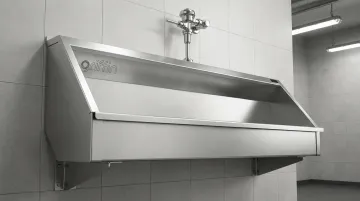
Worth noting: stainless steel's surface properties are well-established, but no peer-reviewed study has directly compared bacterial colonization rates on stainless urinals versus vitreous china. Claims of categorical hygiene superiority should be evaluated carefully.
Composite and Resin Options
Composite and resin urinals are used primarily in portable and modular restroom applications. They're lightweight and inexpensive to produce, but durability over time in permanent commercial installations is a concern. For any facility expecting years of continuous use, ceramic or stainless steel are the more defensible specifications.
Key Specifications and Features to Evaluate
Beyond material, the specifications that control installation cost and long-term performance are often overlooked until a contractor is on-site and the rough-in doesn't match. Get these right in the specification stage.
Rough-In Dimensions and Mounting Height
Rough-in dimension is the distance from the finished wall to the center of the drain or supply connection. This number is not universal — it varies by model and rim height selection.
For example, the Falcon F7000 uses a 10-inch drain rough-in for a 17-inch rim height and a 17-inch rough-in for a 24-inch rim. The F1000 uses 9.75 inches and 16.75 inches respectively. These numbers cannot be interchanged, and no single "standard" commercial rough-in applies across manufacturers.
Mounting height (top of rim from finished floor) is equally critical. The ADA-compliant maximum is 17 inches — that's the accessibility ceiling, not a target every installation must hit. A 24-inch rim height is common in non-ADA commercial settings. Select based on your user population and facility compliance requirements.
Supply Connection and Drain Configuration
Supply line sizing varies by flush type. Per IPC 2018 Table 604.5:
- Flush-tank urinals: ½-inch minimum fixture supply
- Flushometer-valve urinals: ¾-inch minimum fixture supply
Kohler's K-4960-ET uses a ¾-inch top spud and 2-inch outlet spud. Verify these dimensions against existing plumbing before finalizing specs — discrepancies that surface on-site cost significantly more to resolve than those caught at the drawing stage.
ADA Compliance and Installation Requirements
ADA compliance for urinals isn't required in every restroom — but the trigger condition is easy to meet. Per 2010 ADA Standards Section 213.3.3, when more than one urinal is installed, at least one must comply with Section 605.
Required Accessible Urinal Dimensions
Section 605 specifies:
- Rim height: 17 inches (430 mm) maximum above finished floor
- Fixture depth: 13.5 inches (345 mm) minimum, measured from the rim's outer face to the fixture back
- Clear floor space: 30 inches × 48 inches minimum, forward approach
- Controls: Hand-operated or automatic; hand controls must meet Section 309 reach range requirements
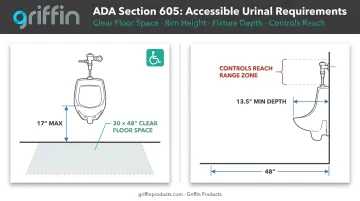
The 2012 Texas Accessibility Standards (TAS) mirror these requirements. TAS dimensions match the federal ADA requirements exactly, but Texas facilities must still confirm compliance with TAS, which carries its own enforcement structure through TDLR.
Plumbing Rough-In for Compliance
Meeting dimensional requirements is only part of the picture. Plumbing rough-in must also align with code before installation begins. Key requirements to verify during the design phase:
- Shutoff valve: IPC 2021 Section 606.2 requires one on each fixture supply line
- Stop valve placement: No single prescribed coordinate — manufacturer geometry controls location
- Local amendments: State and local codes may impose requirements beyond IPC minimums
- TAS review: Texas facilities should review TAS alongside federal ADA standards, not instead of them
Specifying compliant fixtures from the outset reduces both construction cost and compliance exposure. Manufacturers that provide CAD drawings, PDF spec sheets, and Revit files as part of their standard documentation package make this considerably easier for design teams.
Maintenance and Hygiene Best Practices
Even the best urinal will underperform — and fail early — without consistent maintenance. The approach varies considerably between flush and waterless systems.
Water-Flush Urinals
A practical routine for commercial water-flush urinals:
- Daily — Wipe visible surfaces with appropriate cleaner; inspect strainer/screen for debris
- Weekly — Remove and clean strainer or screen; inspect trap for buildup signs
- Quarterly — Full trap inspection; check supply stop valve operation
- Annually — Assess flushometer performance; replace diaphragm or cartridge as needed
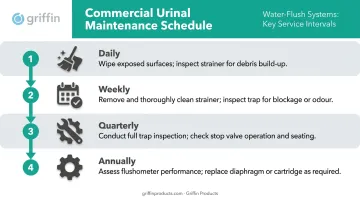
For stainless steel fixtures, Acorn's care guidance specifies avoiding steel wool, hydrochloric acid, sodium hydroxide, and chlorinated cleaners like Clorox. Rinse with fresh water, wipe dry, and work with the grain.
Waterless Urinals
Waterless systems have simpler plumbing than flush models, but they demand one task you can't skip: replenishing the sealant or cartridge before the system fails.
- Falcon systems: Replace cartridge at approximately 7,000 uses, or when maintenance indicators show exhausted performance
- Zurn Z5795: Add 3–4 oz of AquaGreen sealant after every 3,000 uses — this is sealant replenishment, not cartridge replacement
- Sloan WES-150: Follow current product documentation for interval; this varies by installation conditions
Depleted sealant is the documented pathway for odor breakthrough. The most common complaint about waterless urinals — odor — almost always traces back to missed replenishment intervals. Stay on schedule and the system performs as designed.
How to Choose the Right Standing Urinal for Your Facility
No single urinal suits every application. Use facility type, traffic volume, and regulatory context as your primary filters.
Facility-Type Decision Framework
| Facility Type | Priority | Recommended Specification |
|---|---|---|
| Food service / commercial kitchen | NSF compliance, sanitation | Stainless steel, NSF-certified |
| Industrial / manufacturing | Impact resistance, heavy use | 14-gauge stainless, stall-type |
| Schools / healthcare / government | ADA compliance, vandal resistance | ADA-certified, stainless or ceramic |
| Stadiums / arenas | High capacity, cleaning ease | Extended/stall-type, water-flush |
| Hospitality / office | Aesthetics + function | Vitreous china or designer ceramic |
Volume and Traffic Considerations
Two separate code frameworks govern how many urinals you can install — and they use different inputs:
- IPC (2024 Table 403.1): Limits urinals to no more than 67% of required water closets in assembly and educational occupancies, and 50% in other occupancies. Fixture counts are based on occupancy classification, not available space.
- OSHA 29 CFR 1910.141: Applies to workplace sanitation and uses employee headcount rather than occupancy type. Don't substitute one standard for the other.
Always consult your locally adopted code alongside IPC Table 403.1 — local amendments can tighten these limits.
A unit rated for a 15-person office won't hold up in a stadium concourse serving hundreds of users per hour. Before specifying, estimate your peak hourly usage and match material durability, flush volume rating, and maintenance interval accordingly.
Custom Fabrication for Non-Standard Requirements
When standard dimensions, configurations, or compliance requirements fall outside what off-the-shelf products cover, Griffin Products offers custom stainless steel fabrication for commercial clients. Submit a written description and technical drawing, and their sales team will respond with a quote and timeline.
Technical documentation — including CAD DWG files, PDF specs, and Revit RFA files — is available to support architects and contractors through the design phase.
Frequently Asked Questions
What is a standing pee toilet called?
The correct term is a standing urinal or wall-hung urinal. It's a dedicated plumbing fixture designed for standing use, distinct from a toilet, which is designed for seated waste elimination. In commercial restrooms, the terms are used interchangeably in most specifications.
Can females urinate standing up?
Without a device, standing urination requires technique and is not anatomically straightforward for most women. Portable female urination devices (FUDs) are available for outdoor and field use. For commercial restroom design, IAPMO Manual 1-2023 permits urinals in all-gender rooms when placed in privacy compartments.
Is peeing standing up unhealthy?
For individuals with a penis, using a standing urinal is the anatomically natural position. A 2014 systematic review and meta-analysis found no statistically significant urodynamic differences between sitting and standing in healthy men. Men with lower urinary tract symptoms showed lower post-void residual volume when sitting, but this is a clinical consideration for that population, not a general concern.
What is the standard height for a standing urinal?
The ADA-required maximum is 17 inches from finished floor to the top of the rim. Non-ADA commercial installations commonly use a 24-inch rim height. The correct height depends on your facility's compliance requirements and primary user demographic.
What is the difference between a wall-hung urinal and a floor-mounted urinal?
Wall-hung urinals are secured to wall supports and leave the floor clear, making cleaning easier and height adjustment possible. Floor-mounted (stall-type) urinals extend to the floor, suit high-capacity or heavy-duty environments, and offer easier access for some accessibility configurations. Wall-hung units also allow easier access to drain components during maintenance.
Are waterless urinals sanitary?
Yes, when properly maintained. The cartridge or sealant system blocks odors and pathogens from the drain. Their hygiene depends entirely on adherence to the manufacturer's replenishment schedule — Falcon at approximately 7,000 uses, Zurn at 3,000. Missed maintenance intervals are the primary cause of odor and sanitation complaints, not a flaw in the technology itself.