This mismatch causes real headaches. Homeowners cut countertop openings before checking the manufacturer's template, only to find the sink doesn't fit. Bar owners install a single-bowl sink that looks fine, then fail inspection because local health code requires three compartments for washing, rinsing, and sanitizing glassware.
This guide breaks down standard bar sink dimensions for both settings. You'll get sizing factors, commercial NSF requirements, and the installation mistakes that trip up even experienced contractors.
Key Takeaways
- Bar and prep sinks commonly run 12–18 inches wide with 7–10 inches of bowl depth
- Size commercial underbar sinks as multi-compartment units to local health code—not as single bowls
- Cabinet cutouts should match the manufacturer's exact template, not a generic clearance guess
- Plan ADA mounting height and knee clearance separately from bowl size
- Custom fabrication solves sizing problems when standard models don't fit your layout
What Is a Bar Sink?
A bar sink, also called a wet bar sink or underbar sink, is a smaller secondary sink built for drink prep, glass rinsing, and quick cleanup. It's distinct from a full-size kitchen sink. Some makers also split bar sinks and prep sinks into separate lines—Ruvati is one example—though buyers often use the names interchangeably.
"Bar sink dimensions" actually covers two very different products:
- Compact residential prep sinks — decorative, single-bowl, meant for home entertaining
- Multi-bowl commercial underbar sinks — heavy-duty, code-compliant, built for continuous service
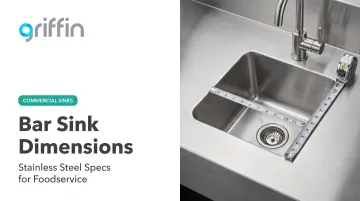
When you're shopping, dimensions are usually expressed as three numbers: exterior width, front-to-back length, and bowl depth. Cabinet or cutout size is a separate measurement entirely, and confusing the two is one of the most common sizing mistakes we'll cover later.
Residential Bar Sinks vs. Commercial Underbar Sinks
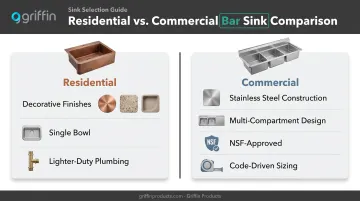
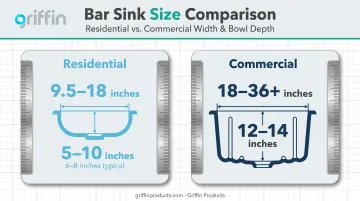
A home wet bar sink is typically a single bowl, roughly 12–18 inches wide, finished in decorative materials like copper, granite composite, or fireclay. Native Trails' Cantina model, for example, is an 18-gauge copper sink measuring 15 x 15 x 7.5 inches on the outside.
Commercial underbar sinks look nothing like that. They're built from 14-gauge or 16-gauge stainless steel, sized for multiple bowls, and engineered for continuous glass washing during a Friday night rush.
- Residential: decorative finishes, single bowl, lighter-duty plumbing
- Commercial: stainless steel, multi-compartment, NSF-approved, code-driven sizing
Restaurants, bars, and catering operations generally can't use decorative residential models. Food service needs NSF-approved stainless compartment and underbar sinks built for commercial dimensions and duty cycles—the type Griffin Products fabricates for commercial kitchens.
Factors That Influence Bar Sink Dimensions
Four factors drive bar sink size more than any others. Get these right before you lock in a model.
Available space comes first. Underbar cabinets, back-bar runs, and tight station layouts often set the maximum footprint before you even consider bowl count or depth.
Intended use changes depth requirements. A sink used only for rinsing glasses needs less depth than one handling ice dump, bar prep, or drain-board overflow. Shallow bowls drain fast and stay easy to reach into; deep bowls hold more without splashing.
Bowl count changes the entire footprint. This is the biggest variable:
- Single-bowl underbar and bar sinks stay compact
- Two- or three-compartment commercial sinks exist specifically to meet wash-rinse-sanitize health code steps
- Each added compartment adds significant width to the overall unit
Material and gauge subtly shift exterior dimensions. Stainless steel gauge (14GA vs. 16GA) changes wall thickness slightly, which affects how interior bowl volume relates to the exterior footprint. Heavier 14GA builds run a bit thicker than 16GA at the same nominal size.
Standard Bar Sink Size Ranges
These ranges are a starting point for research, not a substitute for checking the exact model you're buying. Manufacturers vary widely.
Width and Length Ranges
Published buying guidance from Ferguson puts the typical widest-side measurement at 9.5 to 18 inches for residential bar sinks. Square models are especially popular in tight spaces:
- Native Trails Cantina: 15 x 15 inches outside, 13 x 13 inches inside
- Ruvati Roma RVH8316: 13 inches wide x 15 inches long
- Ruvati Gravena RVH7112: 12 inches wide x 18 inches long
Rectangular or trough-style sinks stretch longer for multi-task use. The Ruvati Gravena RVH7010, for instance, runs 10 x 18 inches, giving more usable length without expanding width.
Commercial territory looks completely different. Griffin Products' Sabine 16GA line alone spans single-bowl configurations from 18 x 18 inches up to 36 x 24 inches, depending on how many compartments and drainboards the setup requires.
Depth Ranges
Bowl depth commonly falls between 5 and 10 inches for residential sinks, with 6–8 inches being the sweet spot for most home bars. Shallower bowls suit quick glass rinsing. Deeper bowls handle ice or dish soaking without water sloshing over the rim.
Commercial bowls run deeper across the board. Griffin's compartment sink lines commonly spec 12-inch bowls, with some models, like the Terrell TE.324 and Wichita WC.244, reaching 14 inches. That extra depth matters when a bar back needs to fully submerge tall glassware or bus tubs during a rush.
Cabinet and Countertop Cutout Sizing
Here's where most DIY projects go wrong. There's no universal "add 3 inches" rule that applies to every sink.
What the manufacturers actually say:
- Elkay recommends a base cabinet 3 inches wider than the sink's overall length, to account for cabinet-wall thickness
- Waterworks' installation guide instructs installers to pull cutting dimensions from the individual product, not a generic formula, and to build the template with the physical sink in its final position
Treat cabinet width and countertop cutout as two separate measurements. Pull both from the specific model's install template, not a rule of thumb.
Griffin Products provides CAD DWG, PDF spec sheets, and Revit RFA files for many compartment sink models. Have that documentation in hand before anyone starts cutting.
Bar Sink Dimensions for Commercial and Food Service Bars
Commercial bars carry compliance weight that residential installs simply don't. Getting the dimensions right is the difference between passing and failing an inspection.
Multi-Compartment Underbar Sink Sizing
The FDA Food Code requires, with limited exceptions, at least three compartments for manually washing, rinsing, and sanitizing equipment and utensils. That single requirement is why commercial underbar sinks look nothing like their residential counterparts.
The code doesn't set a universal minimum bowl size. Instead, each compartment must be large enough to fully immerse the largest equipment or utensil used at that station.
Local jurisdictions often add their own rules. The City of Seguin, Texas, for example, requires compartments that can immerse at least half of the largest item, plus a separate dump sink and NSF certification.
NSF-approved compartment and underbar setups from Griffin Products are built around these code requirements, with specification-grade drains and fittings included standard.
A typical 3-compartment unit, such as the Terrell TE.324, measures 27.5 inches wide, 24 inches front-to-back, with 14-inch bowls. That footprint is far larger than any single-bowl residential sink.
ADA and TAS-Compliant Bar Sink Placement
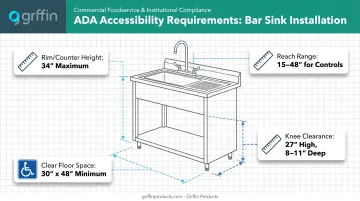
ADA compliance isn't about bowl size at all — it's about access. When a sink installation is required to be accessible, the 2010 ADA Standards set specific measurements:
- Rim/counter height: 34 inches maximum above the finished floor
- Clear floor space: 30 x 48 inches minimum, positioned for a forward approach
- Knee clearance: 27 inches high, minimum 8-11 inches deep depending on height
- Reach range: 15–48 inches for operable controls
For multi-bowl commercial sinks, only one bowl needs to meet knee and toe clearance requirements, not every compartment. Griffin Products' Brazos and Blanco handwash lines are documented ADA/TAS compliant configurations, which matters when bar service and accessibility share the same footprint.
Material Gauge and Durability Considerations
Once sizing and placement clear code, material choice decides how long the sink holds up. Commercial bars favor heavier stainless gauges over decorative residential materials because a sink washing hundreds of glasses a night has to take that abuse and stay easy to sanitize.
- 14-gauge stainless (roughly 0.075 inches thick) suits heavy industrial and high-volume use
- 16-gauge stainless (roughly 0.059 inches thick) still handles commercial-grade foodservice demands
Griffin's Wichita and Trinity lines run 14GA; Sabine, Terrell, and Pecos run 16GA — and notably, gauge doesn't change a given model's nominal exterior dimensions. Those are set by the model and configuration, not the metal thickness.
When standard sizing doesn't fit a facility's layout (an odd-shaped bar back or a narrow service corridor), custom fabrication is the fallback. Griffin Products accepts a description or drawing through its custom-order process and specs a solution from there.
Installation Considerations and Common Sizing Mistakes
Even well-planned projects run into snags. These three mistakes account for most of them.
- Trusting the "nominal" size blindly. A sink advertised at a round number rarely matches the exact cutout needed. Pull cutting dimensions from the individual sink, not the marketing spec, and build your template with the physical unit in place.
- Forgetting front-to-back clearance. Faucets, soap dispensers, and backsplashes all need room. Plan that space before cutting, not after the countertop is already down.
- Underestimating structural support. Stainless steel compartment sinks and multi-bowl commercial units are heavy. Undermount installs need internal framing that's properly secured and leveled. Skip that step, and you're looking at a sagging countertop within a year.
Before ordering, confirm the sink, faucet, and cabinet dimensions all line up. It's a five-minute check that saves a lot of rework.
Frequently Asked Questions
What is considered a bar sink?
A bar sink is a smaller secondary sink, residential or commercial, used for drink prep, glass rinsing, and quick cleanup. It's distinct from a full-size kitchen sink and typically sits behind a wet bar or service bar.
What is the average size of a bar sink?
Residential bar sinks typically run 12–18 inches wide with 5–10 inches of bowl depth. Commercial underbar sinks are considerably larger, often spanning 18–36+ inches once multiple compartments are added.
What size cabinet do I need for a bar sink?
There's no single universal clearance rule. Manufacturers typically recommend a cabinet about 3 inches wider than the sink's overall length to allow for wall thickness. Always confirm against the manufacturer's cutout template before cutting.
What is a good size for a wet bar?
Home bar counters commonly sit around 42 inches high, with work surfaces behind them closer to 36 inches. Depth varies depending on whether you're measuring the drink ledge, the full bar cap, or the back-bar counter.
What is the standard depth of a bar sink bowl?
Most residential bowls run 6–8 inches deep, which suits quick rinsing. Deeper bowls, closer to 10 inches, work better for ice storage or dish soaking.
Do commercial bars need different sink dimensions than home wet bars?
Yes. Health codes drive commercial bars toward multi-compartment, NSF-approved sinks sized for wash, rinse, and sanitize. Those layouts need a much larger footprint than residential single-bowl bar sinks.