
The good news is that modern low-flow faucets are engineered to deliver genuine performance at reduced flow rates. The catch is that "low-flow" means different things depending on whether you're outfitting a private hotel bathroom, a restaurant handwash sink, or a public restroom. Getting those distinctions wrong is more common than most buyers realize.
This guide covers the definitions that actually matter, the certifications commercial buyers need to verify, how to match faucet type to application, and how to install and troubleshoot low-flow faucets correctly.
Key Takeaways
- A low-flow sink faucet delivers 1.5 GPM or less — EPA WaterSense certification is the benchmark for private-use lavatories
- Low-flow doesn't mean weak flow — aerator design creates a full-feeling stream while reducing actual water volume
- Commercial food service and public restrooms follow different flow rate codes than residential fixtures — know which standard applies before you buy
- NSF/ANSI 61 and 372 certifications are required for potable water contact in food service environments
- ADA compliance is mandatory for public-facing facilities, including restrooms and handwash stations
- Most post-installation flow complaints trace back to a clogged aerator or a partially closed supply valve — not a defective faucet
What Is a Low-Flow Sink Faucet? Understanding GPM Standards
The Numbers Behind "Low-Flow"
A low-flow faucet restricts water delivery compared to the federal baseline of 2.2 GPM at 60 psi for general sink faucets. EPA's WaterSense program sets 1.5 GPM at 60 psi as the maximum for certified private-use lavatory faucets, while also requiring a minimum of 0.8 GPM at 20 psi so the faucet stays functional in low-pressure buildings.
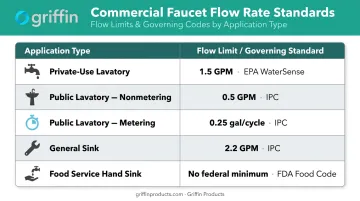
WaterSense doesn't cover every faucet type, and thresholds vary by application:
| Application | Flow Limit | Governing Standard |
|---|---|---|
| Private-use lavatory (hotel, hospital room) | 1.5 GPM max at 60 psi | EPA WaterSense |
| Public lavatory, nonmetering | 0.5 GPM at 60 psi | 2021 IPC Section 604.4 |
| Public lavatory, metering | 0.25 gal/cycle | 2021 IPC |
| General sink faucet | 2.2 GPM at 60 psi | 2021 IPC (local codes may differ) |
| Food service hand sink | No federal GPM minimum | FDA Food Code 2022 |
The FDA Food Code requires water at at least 85°F and self-closing faucets that flow for a minimum of 15 seconds without reactivation — but sets no minimum GPM. Verify your local health department's requirements separately.
Flow Rate vs. Water Pressure
Flow rate (GPM) measures the volume of water delivered per minute; water pressure (psi) is the force pushing water through the pipes. A low-GPM faucet restricts volume at the outlet without reducing building water pressure.
The 60 psi figure in most ratings is a test reference condition, not a minimum service requirement. The 2021 IPC uses 8 psi as the design minimum for lavatory and sink faucets, though individual faucet manufacturers may specify higher minimums (some commercial models list 20–125 psi operating ranges).
How Aerators Work
An aerator is a mesh screen installed at the faucet tip. It mixes air into the water stream, producing a larger, softer flow that resists splashing. Because the aerated stream occupies more of the flow path, a 0.5 GPM faucet can feel comparable to a 1.5 GPM faucet in everyday use.
One important exception: healthcare facilities may want laminar flow outlets instead of aerators, since aeration can disperse bacteria in clinical environments. For healthcare applications, include infection control staff in faucet selection — the wrong outlet type can create compliance and safety risks.
What to Look for When Buying a Low-Flow Sink Faucet
Match GPM to Application, Not Just the Lowest Number
The instinct to select the lowest available GPM is understandable, but it can create compliance problems. Food service hand sinks have no federal GPM floor, but some jurisdictions have adopted minimums. Utility sinks may need higher flow for functional cleaning. Always verify local health department and plumbing code requirements before finalizing a flow rate.
Certifications That Matter for Commercial Buyers
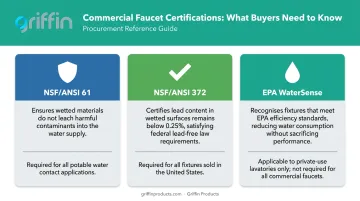
Three certifications are relevant for most commercial applications:
- NSF/ANSI 61 — Evaluates whether faucet components leach harmful contaminants into drinking water. Required by many adopted plumbing codes for potable water contact applications
- NSF/ANSI 372 — Verifies that weighted lead content across wetted surfaces stays below 0.25% (0.2% for solder and flux), satisfying federal lead-free requirements
- EPA WaterSense — Validates water efficiency for private-use lavatories specifically; does not cover public or commercial kitchen faucets
Beyond these three, federal law requires covered drinking-water products to carry third-party lead-free certification from an ANSI-accredited body. NSF is one accepted certifier, but not the only one — verify the actual certification listing rather than relying on marketing language.
ADA requirements add another layer. Faucet controls must operate with one hand, without tight grasping, pinching, or wrist twisting, with no more than 5 lbf of force. Metering faucets at accessible sinks must stay open for at least 10 seconds.
Handle Type for the Application
Handle selection affects both compliance and workflow:
- Wrist-blade handles — Common in food service environments where hands may be soiled; the FDA Food Code doesn't mandate them, but many local health departments do
- Sensor/touchless faucets — Standard in healthcare and institutional settings; EPA's 2023 commercial guidance notes sensors don't automatically reduce water use since they open fully and can activate unintentionally — evaluate cycle volume and shutoff timing carefully
- Lever handles — Appropriate for back-of-house, utility, and private-use applications where the ADA 5 lbf requirement is met
Handle type doesn't control flow rate — a wrist-blade model can deliver anywhere from 0.5 to 2.2 GPM depending on the outlet selected. Verify the specific handle-outlet-model combination before purchasing.
Construction Quality and Sink Compatibility
In high-volume environments, residential-grade chrome finishes fail quickly. Specify heavy-gauge brass or stainless steel bodies rated for frequent daily use. Griffin Products bundles specification-grade commercial faucets with their NSF-approved stainless steel sink lines — the Sabine, Trinity, Wichita, and Terrell series each ship with a sized faucet, basket drains, and a wall-mount installation kit, so there's no separate hardware sourcing required.
Before ordering, confirm:
- Deck mount vs. wall mount compatibility
- Faucet hole count and center spacing (4" vs. 8" centers)
- Spout reach relative to basin depth
- Supply line connection size (typically 3/8" compression)
Low-Flow Faucet Types by Application
Manual Lever and Wrist-Blade Faucets
The most common choice for commercial food service. Flow rate depends on the outlet, not the handle. Real-world examples from commercial manufacturers show wrist-blade models spanning 0.5 GPM to 2.2 GPM depending on the aerator or spray outlet specified. Buyers must verify the complete model configuration rather than assuming the handle type implies a particular flow rate.
For food service handwash sink specifications, Griffin Products offers wrist-blade handle configurations across their catalog as standard, optional, or configurable options on more than 25 products.
Sensor and Touchless Faucets
Increasingly common in healthcare and institutional settings. The hygiene argument is clear: touchless activation eliminates a cross-contamination point. However, EPA's 2023 commercial faucet guidance cautions that sensor faucets may not save additional water compared to manual alternatives because they typically open fully and can activate unintentionally. Savings depend heavily on proper commissioning, sensor calibration, and shutoff timing.
Griffin Products' Blanco multi-station handwash sinks are available with electronic deck-mounted and wall-mounted sensor faucets, including a thermostatic mixing valve, which is particularly relevant for healthcare facilities managing water temperature compliance.
Pre-Rinse and Utility Faucets
Pre-rinse spray valves are a separate product category from handwash faucets and should not be compared using the same GPM benchmarks. DOE classifies them by spray force, with three distinct tiers:
- Class 1: 1.00 GPM
- Class 2: 1.20 GPM
- Class 3: 1.28 GPM
These are trigger-operated warewashing devices. Their flow standards exist independently of handwash or lavatory faucet codes.
How to Install a Low-Flow Sink Faucet: Step-by-Step
Tools and Materials Needed
- Adjustable wrench
- Basin wrench (essential for confined spaces under deep commercial sinks)
- Plumber's (Teflon) tape
- Bucket
- The faucet kit — most commercial-grade units include mounting hardware and supply lines
Many commercial sinks bundle installation kits as standard. Griffin Products, for instance, includes a wall-mount faucet installation kit with every sink across their Sabine, Terrell, Trinity, and Wichita lines.
Once you have your tools and kit confirmed, work through the following steps in order.
Step 1 – Shut Off Water and Clear the Workspace
Turn off supply valves under the sink. If zone valves are absent, shut off at the main. Open the faucet to release residual pressure, then place a bucket under the supply lines before disconnecting anything.
Step 2 – Remove the Old Faucet
Disconnect supply lines with an adjustable wrench. Use a basin wrench to unscrew the mounting nut from below the deck (the long handle reaches where a standard wrench cannot). Lift out the old faucet and inspect the sink deck for corrosion or damage before proceeding.
Step 3 – Install the New Faucet
- Feed the new faucet through the mounting hole(s)
- Apply plumber's tape to all threaded connections
- Hand-tighten the mounting nut from below, then snug with a wrench — do not overtighten
- Connect hot and cold supply lines (hot on left, cold on right by convention)

Step 4 – Test and Adjust
Slowly reopen supply valves and inspect all connections for leaks. Run the faucet to flush debris. If initial flow seems restricted, remove and clean the aerator — manufacturing debris frequently clogs the screen on first use.
For sensor faucets, follow the manufacturer's calibration instructions for sensor range and power connection .
Troubleshooting Common Low-Flow Problems After Installation
Most low-flow issues after installation trace back to a handful of common causes. Work through these scenarios before calling a plumber or ordering replacement parts.
Weak flow immediately after installation
- Check that supply valves are fully open and supply lines aren't kinked
- Remove and rinse the aerator — manufacturing debris often clogs the screen on first use
Flow drops over time
- Mineral buildup in the aerator is the most common cause
- Remove the aerator and soak it in a 50/50 white vinegar and water solution for about 60 minutes, then rinse thoroughly and reinstall
- If flow remains low after aerator cleaning, inspect the cartridge or internal filters for scale deposits
Weak flow across all faucets in the facility
- This points to a systemic pressure problem, not a faucet defect
- Measure flowing pressure at the fixture and compare against the faucet manufacturer's minimum operating psi
- Swapping to a higher-GPM aerator will not fix a pressure problem
- Contact a licensed plumber if facility pressure falls below the manufacturer's specified minimum
Frequently Asked Questions
What is considered a low-flow sink faucet?
A low-flow sink faucet delivers 1.5 GPM or less at 60 psi, with EPA WaterSense certification as the recognized benchmark for private-use lavatories. Public restrooms and commercial food service sinks operate under different thresholds — often as low as 0.5 GPM — depending on the adopted local plumbing code.
Are low-flow sink faucets worth it?
Yes, for most settings. EPA estimates that replacing standard bathroom faucets with WaterSense-certified models saves around 700 gallons annually compared to the 2.2 GPM federal baseline. In commercial facilities with dozens of fixtures running multiple shifts, those savings compound across every faucet.
What GPM is best for a commercial kitchen handwash faucet?
Most commercial handwash faucets operate between 0.5 and 1.5 GPM. The FDA Food Code sets no federal minimum, but some jurisdictions have adopted their own minimums. Verify local health department and plumbing code requirements before selecting a flow rate — going too low can create compliance issues.
Do low-flow faucets require NSF certification for food service use?
NSF/ANSI 61 (contaminant leaching) and NSF/ANSI 372 (lead content) are the relevant standards for potable water contact in food service. Federal law requires third-party lead-free certification from an ANSI-accredited body. Commercial buyers typically need both NSF certifications — plus WaterSense compliance for efficiency and applicable local code requirements.
How do I fix a low-flow faucet that suddenly has even lower flow?
Start by removing and cleaning the aerator: sudden flow reduction is most often caused by mineral buildup blocking the screen. Next, check that supply valves are fully open. If both check out, measure facility water pressure; a drop in line pressure across multiple fixtures points to a systemic issue rather than the faucet itself.
Can I install a low-flow faucet myself on a commercial sink?
The basic steps are the same as residential: shut off water, disconnect, mount, reconnect, test. However, many jurisdictions require a licensed plumber for commercial installations — particularly in food service or healthcare facilities subject to health inspections. Check local code requirements and the terms of any facility permits before proceeding with a DIY installation.